|
THE REVELATION OF JESUS CHRIST
The Search 5:2-4
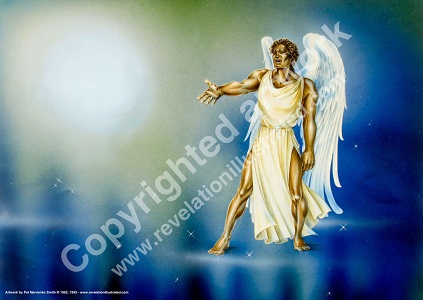
Then I saw a strong angel proclaiming with a loud voice, "Who is worthy to open the scroll and to loose its seals?" And no one in heaven or on the earth
or under the earth was able to open the scroll, or to look at it.
So I wept much, because no one was found worthy to open and read the scroll, or to look at it. - Revelation 5:2-4
Then the Apostle John said "I saw a strong angel." Could this heavenly messenger have been Gabriel or Michael?
It is not likely since he was not named. In verse 11 of this same chapter we will see that there are myriads of angels--a nearly uncountable number of
them--worshipping the Lord Jesus. Yet only four angels are named in the Bible, and two of them were fallen angels (demons): Satan (aka. Lucifer, Beelzebul)
and Abaddon (aka. Apollyon). The other two of course are Gabriel and Michael. Details about individual angels are sparse in God's Word. Too much information
could lead some people into idolatrous practices. Nevertheless, there is strong evidence that the Seraphim, Cherubim, and Living Creatures that we have
been considering in this section are on a higher level than other angels, and others, like Gabriel and Michael have important special functions.
The Apostle Paul mentioned organizational levels of demons also:
Finally, my brethren, be strong in the Lord and in the power of His might. Put on the whole armor of God, that you may be able to stand against the
wiles of the devil For we do not wrestle against flesh and blood, but against principalities, against powers, against the rulers of the darkness of
this age, against spiritual hosts of wickedness in the heavenly places. Therefore take up the whole armor of God, that you may be able to withstand
in the evil day, and having done all, to stand. - Ephesians 6:10-13
This angel that John saw was a "strong" angel. Compared to human beings, it appears that all angels are strong. This one would be
considered strong among other angelic beings. The Greek word used (ischyron) describes "combative strength."
This strong angel was proclaiming with a loud voice, "Who is worthy to open the scroll and to loose its seals?"
With his supernatural strength, this messenger's task was to proclaim this vital message far and wide since it is of great importance to people all over the earth.
Where would they ever find the one being who was qualified to receive this prophetic message about the End Times?
The quest for one who is "worthy" is related to the thought at the end of Chapter 4, where the elders were saying to the Father,"
You are worthy, O Lord." As we saw there, the Father was worthy to receive glory, honor and power. God the Father is the worthy author of the
contents of the scroll. But now the search is begun to find the worthy recipient of the scroll: the one who had somehow earned the right to see the
prophecies of the future and reveal it to the readers of this book.
Unfortunately, John reported that they could find no one who was qualified to receive the scroll. The search began
in heaven, the most obvious place to find a worthy recipient. Even the mighty angels--the many "messengers" in this book, would
not be qualified to open the scroll.
Next, the search proceeded on the earth. No mere human would qualify, however rich or powerful or revered he
or she might be.
In desperation, even those under the earth were considered, but to no avail. In several Old Testament
passages hell is described as below the ground (Numbers 16:30; Deuteronomy 32:22; Psalm 55:15; Proverbs 5:5; 9:18; 15:24; Isaiah 14:9-11; Ezekiel 31:15-18).
Jesus warned his listeners not to end up in "hell fire" (Matthew 5:22-30; 10:28; 18:9). The Greek word translated "hell" is geenna, meaning
"the Valley of Hinnom." This was a word picture of the deep valley south of Jerusalem where the city's refuse was dumped and burned. Later in our study
of Revelation we will see that some demons have been confined in the abyss or "bottomless pit" and will be released to torment evildoers during the
Tribulation (Revelation 9:1-2, 11; 11:7; 17:8). At the end of the Tribulation Satan will be confined in this bottomless pit during the thousand year
reign of Christ (Revelation 20:1, 3). Another symbolic description of future torment is called the "lake of fire" in Revelation. This will be the
final destination of Satan, his associates, and those who reject Jesus Christ as Savior (Revelation 19:20: 20:10-15).
After this great search throughout the universe, still, no one was found who was able to open the scroll.
The word "able" comes from the Greek dunamai, "to have power." This is the word used to describe the explosive potential of "dynamite."
Furthermore, no one was even found who had the right even to look at it. It was like a "top secret" document
that was so important that it could not be allowed to be seen by those who do not have the "need to know" its contents.
During one phase of my life, when I was a pastor, but needed to supplement my income, I worked for a computer sub-contractor
to McDonnell-Douglas during the planning of the Space Station. Some of the related defense ventures there were "black projects" inside "vaults"
that could only be entered with people who had the highest governmental clearance. When one of their workstations needed repair, I would have
to enter the vault to replace it or fix it, but I could only do so if I was accompanied by a project team member. As we would walk through
the hall, every few feet my guide would say "uncleared," meaning that he was escorting someone who should not see any of their work. They would
cover their desks, and turn off their computer monitors as I would pass by.
The contents of this scroll-the details of the seven seals, and therefore of the rest of the Book of Revelation, simply had to
be handled by the right person. The situation was so disappointing to John that he wrote, "So I wept much." It is hard to
imagine the wise, strong and brave Apostle John breaking down in tears. But trying to put ourselves in his frame of mind, it helps us understand
the incredible importance of those words on the scroll--unveiling the future of the human race. John was frustrated, thinking that the information
would not be revealed because no one was found worthy to open and read the scroll.
|